
PART 1: THURSDAY 2.30 – 5.30pm
2.30 Welcome and introduction
2.35 Jasmine Farram, Heritage of London Trust: Surviving Against the Odds: the Case Study of the Southwark Park Caryatids.
Questions
3.30 Matt Nation, Taylor Pearce Ltd: The Agra Colonnade, Conservation and Installation of a Seventeenth-Century Indian Architectural Masterpiece.
Questions
4.00 Lewis Proudfoot, Cliveden Conservation: How to Protect Outdoor Statues from Winter Damage
Questions
4.45 Karin Janzon, The Hove Plinth: Maintenance of Public Sculpture in a Punishing Seaside Climate
Questions
5.15 Closing discussion
PART 2: FRIDAY 10.30am – 5.30pm
10.30 Welcome and introduction
10.35 Rupert Harris, Rupert Harris Conservation Ltd: The Reimagining of George Square and the Restoration of the Bronze Statuary
Questions
11.45 Lewis Proudfoot, Cliveden Conservation: Restoring Stowe National Trust Statues: Heritage Craftsmanship
Questions
12.30 Hal Jacob, Plowden & Smith Ltd: Beyond the Surface: Structural Interventions in Public Sculpture – The Silverdale Mining Tribute Memorial
Questions
1.30 – 2.30 Lunch
2.30 Paul Johnson, National Memorial Arboretum: Funding, Care and Maintenance of Memorials and Sculptures at the National Memorial Arboretum.
Questions
3.10 Dr Samantha Bunning, War Memorials Trust: Funding War Memorials Conservation: Common Challenges Encountered and How Best to Avoid Them.
Questions
4.00 Tea
4.30 Alex Wenham, award-winning stone carver: A Working Plan to Restore Francis Bird’s Damaged Marble Statue of Queen Anne and its Supporting Figures.
Questions
5. 15 Closing discussion
Abstracts of papers & speakers’ biographies
Conservation and Maintenance of Public Sculpture: meeting challenges and continued care.
Part 1 THURSDAY 16 April 2026
Jasmine Farram, Heritage of London Trust
Surviving Against The Odds: The Case Study of the Southwark Park Caryatids.
From Rotherhithe Town Hall to Southwark Park, this talk will trace the history of two caryatids from being sculpted by Henry Poole in 1897 to grace the front of Rotherhithe Town Hall, surviving the Blitz, then their rescue and relocation to the Brutalist Heygate Estate in 1974, being saved from demolition again and finally relocated to Southwark Park in 2011 and their restoration in 2025. Additionally, the talk will uncover the work of Heritage of London Trust, London’s independent heritage charity helping to restore historic buildings and monuments across the city.
Jasmine Farram is Head of Projects at Heritage of London Trust and oversees their grant programme, managing a range of restoration projects across all London Boroughs. Her background is in heritage project management in major capital projects including national museums and a range of historic buildings and churches across the country.
******
Matt Nation, Taylor Pearce Ltd
The Agra Colonnade, Conservation and Installation of a Seventeenth-Century Indian Architectural Masterpiece
The Agra Colonnade is an architectural gem in the care of the V&A Museum. It was once part of the portico of a bath house, built for the emperor Shah Jahan in the 1630s, at the Red Fort in Agra, India. It is a large and beautiful artefact made from white marble with intricately inlaid coloured stones. Taylor Pearce were commissioned to carry out cleaning and repairs prior to it being installed in the new V&A East Storehouse, where it can now be seen again after more than 60 years in storage.
Matt Nation, Director of Taylor Pearce Ltd, has been working as a sculpture/architectural conservator for over 30 years.
******
Lewis Proudfoot, Cliveden Conservation
Winter Covers: How to Protect Outdoor Statues From Winter Damage
Outdoor stone statuary, urns and fountains are at the mercy of the weather during the colder and wetter months. Moisture infiltration and freeze-thaw cycles can damage even the most robust stonework. But with the right preventative measures, valuable historic works of art can be safeguarded against winter’s ravages.
In this paper, Lewis Proudfoot, Managing Director of Cliveden Conservation, provides a comprehensive guide to safeguarding your outdoor stone assets during the winter. He will discuss how repeated freeze – thaw cycles cause damage and will provide practical strategies for proactive monitoring and maintenance. Lewis will also introduce the concept of protective Winter Covers and explain how they can extend the lifespan of valuable historic outdoor statuary and reduce the need for costly repairs. This webinar is designed to guide and support estate managers, curators and custodians of heritage assets with actionable advice from a leading conservation expert.
******
Karin Janzon, The Hove Plinth
Maintenance of Public Sculpture in a Punishing Seaside Climate
This talk will describe and review the three-pronged approach of Prevention, Monitoring and Scheduled Maintenance taken by the Hove Plinth project to safeguard and ensure longevity of major commissioned public sculptures. The presentation will also address costs and funding implications.
Karin Janzon (MSc) is a Trustee of Hove Civic Society and Project Director for Hove Plinth. In her professional career she worked as a senior manager for research and planning in local authority social services, and later as a private consultant. During 2024/25 she was part of a steering group overseeing an Arts Council funded Visual Arts Review for Brighton & Hove.
******
Part 2 FRIDAY 17 April 2026
Rupert Harris, Rupert Harris Conservation Ltd
The Reimagining of George Square, Glasgow and the Restoration of the Bronze Statuary
As the project to re-landscape George Square in Glasgow is still underway, this talk will be an up-to-date account of the work associated with the restoration of the eleven nineteenth century monumental bronze statues. Covering the tendering, planning, logistics, research, the technical processes and politics associated with a complex scheme with tight deadlines.
Rupert Harris studied sculpture and history of art, following this he became assistant to sculptor Lynn Chadwick, after which Rupert established with two others a bronze sculpture foundry. In 1979 he joined the V&A Metalwork Conservation, undertaking a four-year Post Graduate Diploma course. In 1982 he set up his own conservation practice specialising in all metals, ranging from small, decorative objects to monumental sculpture and architectural ironwork. The studio now specialises in all sculptural materials ranging from plastics, glass and timber to metals, terracotta and marble.
In 1982 Rupert was appointed National Metalwork Conservation Advisor to The National Trust and in 2003 was appointed Architectural Metalwork Consultant to English Heritage now Historic England. Rupert is a PACR Accredited Conservator-Restorer and holder since 2007 of a Royal Warrant from HM Queen Elizabeth II and now HM Charles III. Rupert a member of the Institute of Conservation and an elected Fellow of the Royal Society of Arts.
Rupert has 44 years’ experience of the surveying and conservation of sculpture, three-dimensional works of art and architectural and industrial objects, including project management and consulting on many large, complex public monuments, architectural metalwork and important works of art both in the UK and internationally.
******
Lewis Proudfoot, Cliveden Conservation
Stowe National Trust: Restoring Stowe National Trust Statues: Heritage Craftsmanship
Stowe Landscape Garden is one of Britain’s most celebrated historic landscapes, and the National Trust has embarked on an ambitious long-term programme to reinstate the lost temples and monuments that once dressed its gardens like pieces of a theatre set. Over many years, Cliveden Conservation has been a trusted partner in that restoration, taking on some of the project’s most technically demanding commissions.
Three of those projects are presented here as case studies. The first is the recreation of the Nine Muses, and a Lyric Apollo , a set of ten statues recreated from just three surviving originals. Using these three base moulds, Cliveden Conservation were able to cast replica statues and then reconfigure these models to recreate the missing muses.
The second case study is the reinstatement of the Wrestlers and Gladiator, two martial statues absent from Stowe for a century following the great house auctions of the 1920s, faithfully replicated using original statues at St Paul’s Walden Bury and Blenheim Palace as source material.
The third is the Gothic Cross, a three-tiered monument destroyed by a falling tree in the twentieth century. It was rebuilt from little more than fragments and a single illustration, using Coade Stone.
These three projects illustrate the varied approaches and specialist techniques required to reinstate lost heritage, demonstrating Cliveden Conservation’s ability to deliver complex commissions to the highest conservation standard.
******
Hal Jacob, Plowden & Smith Ltd
Beyond the Surface: Structural Interventions in Public Sculpture – The Silverdale Mining Tribute Memorial
To be completed
******
Paul Johnson, National Memorial Arboretum
Funding, Care and Maintenance of Memorials and Sculptures at the National Memorial Arboretum
The National Memorial Arboretum has over 400 memorials across the site and consequently a duty to manage the life of these memorials. The talk will describe how the maintenance and repairs of these memorials are funded. How decisions are made about new installations, amendments to existing memorials, and the difficult decisions that may need to be made in the future around orphaned memorials.
The talk will address the practicalities of day-to-day maintenance, the balance of skilled and unskilled labour, and working with a majority volunteer workforce. It will also discuss the difficulties that arise from our contractual obligations and the expectations of the many stakeholders.
Paul Johnson is the Grounds and Landscape Manager at the National Memorial Arboretum, Alrewas in Staffordshire. Having left school with no career path mapped out, Paul joined a YTS apprenticeship scheme working at a local garden centre. After completing the two year apprenticeship Paul went on to complete a National Certificate in Horticulture at Broomfield College, Derbyshire, before working in various areas of horticulture, grounds maintenance. Having work most recently for a national green space grounds maintenance company, in 2019 Paul moved to work at the National Memorial Arboretum taking responsibility for the maintenance of the 150 acres of grounds and all that sits within them, not least of which is the iconic Armed Forces Memorial. In addition, the role involves the maintenance and care of the plethora of different memorials and sculptures spread across the site. The type of memorials range across a wide spectrum, a memorial plaque mounted on a rock, metal plaques on a brick plinth, glass sculptures, and stainless and Corten steel to bronze sculptures and plaques.
******
Dr Samantha Bunning, War Memorials Trust
Funding War Memorials’ Conservation: Common Challenges Encountered and How Best to Avoid Them
War Memorials Trust works to support communities who care for the war memorials which remain our shared ongoing tribute and responsibility. Encouraging best conservation practice gives the greatest chance of preserving the original war memorials as they were seen by those who lost loved ones. As a charity, War Memorials Trust, provides advice, offers grants and works with others to achieve its objectives.
War Memorials Trust have been funding conservation and repair projects to war memorials since 1998, and during that time, there have been a variety of experiences, some good, and some bad, that custodians of war memorials have encountered. This talk will aim to introduce delegates to the processes involved with applying for grants and the considerations which should be taken both before a project is started and during the completion of the works. Using examples of projects previously funded by War Memorials Trust, we will discuss some of the most common issues encountered and make recommendations on how applicants can mitigate against them whilst in the project planning stage. Examples of the challenges encountered include finding appropriate contractors, ensuring works meet best conservation practice, whilst also managing public expectations of what the result of works should be.
Dr Samantha Bunning started working at War Memorials Trust as a Conservation Officer in August 2024. She had a background in archaeology, specifically the archaeology on conflict as she completed a Masters in Battlefield and Conflict Archaeology at Glasgow University before completing her PhD thesis focusing on the perceptions of warfare in Medieval Wales at Bangor University in 2015. Recently, Samantha has turned her attentions to conservation following the purchase of a Grade II listed timber framed house in mid-Wales with her family. In September 2023, she signed up to study for a PGCert at Birmingham City University in Conservation of the Historic Environment that she has now completed. Her role at the Trust combines her interests in past conflicts with her passion for conservation. Samantha provides Technical Advice through casework and supporting grant projects.
******
Alex Wenham, award-winning stone carver
A Working Plan to Restore Francis Bird’s Damaged Marble Statue of Queen Anne and its Supporting Figures
The Statue of Queen Anne and its four supporting figures representing Britannia, France, Ireland, and America, which currently stand outside the facade of St Paul’s Cathedral, are replicas from the 1890s of the original c.1712 marble statues by Francis Bird, which since the time of their replacement have been in private ownership in Hastings, and are now to be restored and displayed in a public setting in the same locality. The original statues have suffered great neglect over the centuries, including some very aggressive recent vandalism (heads broken off, limbs missing). The current project is making use of the clean Victorian copies in London to make an informed full restoration of the vandalised original statues for public display. This project is currently a work-in-progress, having reached the stage of creating all the working models for the recreation of the missing volumes, and Alex is currently awaiting a shipment of marble from Carrara before moving to the stage of recreating the missing stonework. Alex’s talk will look at the history of this project, and on how modern technology (3D scanning and 3D printing) have been employed to great effect in the process of understanding the missing volumes to recreate, and in getting consent for their restoration from the local authority.
Alex Wenham runs a workshop in Oxford specialising in both the conservation of historic carved stonework and the creation of new carvings. Over a career of 25 years, he has provided carving and conservation work for prestigious projects such as the Houses of Parliament, St Paul’s Cathedral, Blenheim Palace, Chartres Cathedral, the Louvre, Château de Versailles, St Pancras Station, and many more. Since establishing his workshop in Oxford in 2016 , he and his team work regularly for the University and Colleges of Oxford. In addition to various consulting roles,he is the formal advisor on stonework to the Diocese of Oxfordshire, with advisory oversight of over 800 listed churches.
Conservation and Maintenance of Public Sculpture: meeting challenges and continued care
An online Zoom webinar, free for PSSA Members. £5.00 for non-members (join the PSSA).
Free tickets and charged tickets book via Eventbrite
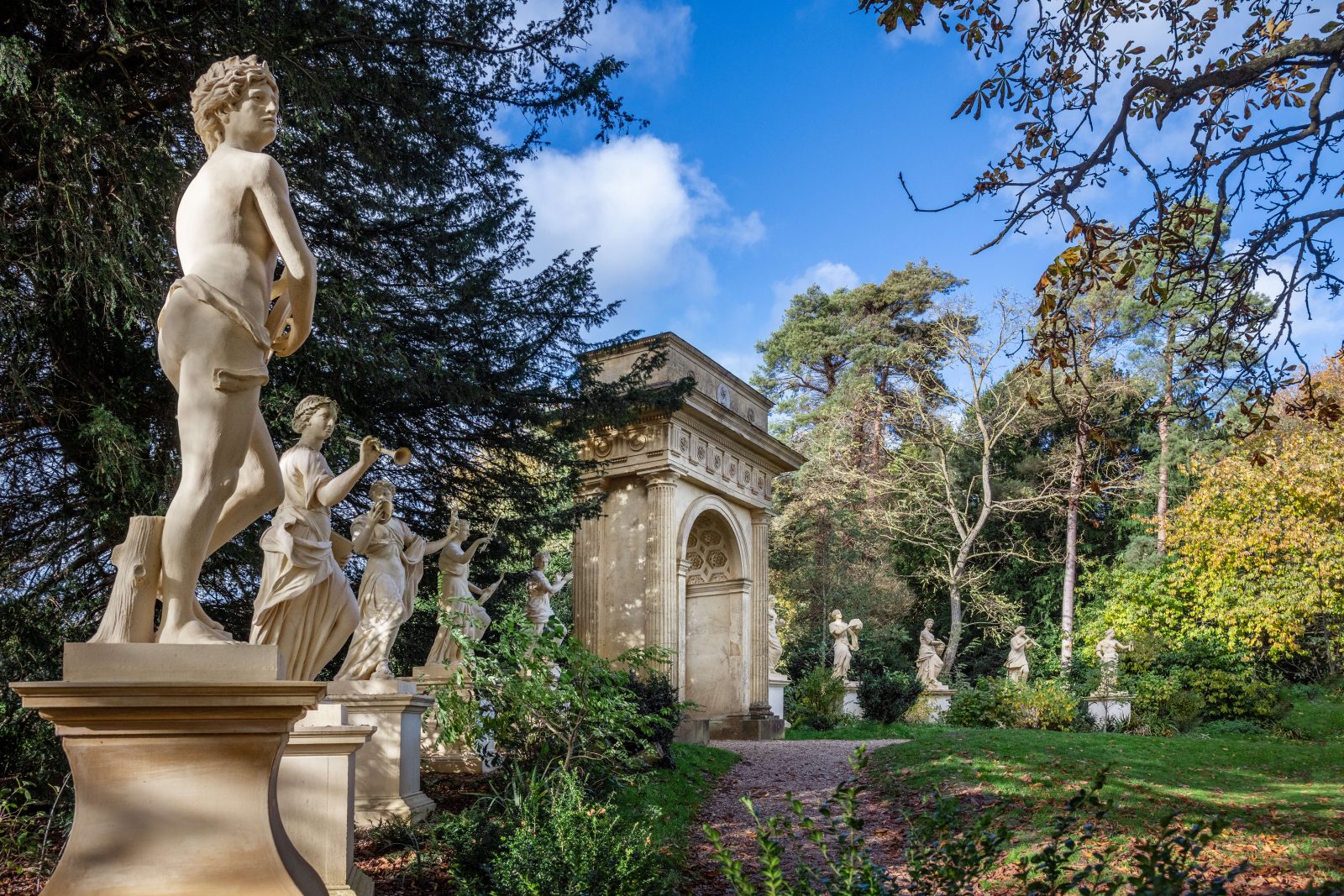
Apollo and The Nine Muses at Stowe Gardens, Buckinghamshire (NT). Photo: Cliveden Conservation.