
Gansey Knitter
Location: The Whitby Sculpture Trail
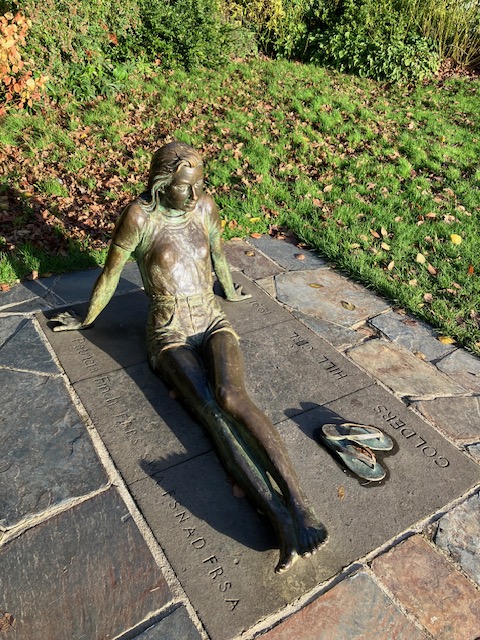
Photo: © PSSA
Sculptor: Patricia Finch (1921–2001)
Founder: Morris Singer (flip flops replaced in 2003 by Meridian Bronze Foundry, Peckham)
Materials: Bronze figure and flip flops, with rectangular paving surround.
Dimensions: l. 153 cm., w. 101 cm. h. 90cm.
Signed and dated: Patricia Finch
1991
Inscription: Left-hand side: Patricia Finch FRBS. SWA. FSN. A.D. F.R.S.A.; Right-hand side: GOLDERS HILL GIRL 1991
Golders Hill Girl
The well-liked Golders Hill Girl was donated to the park in 1991 by the sculptor and medallist, Patricia Finch, who lived locally on the Finchley Road. She made the work at the suggestion of her husband, because the park had meant a great deal to her throughout her life, from having been taken there regularly in her pram, playing there as a child to later taking her own daughters to do the same.
The young girl, depicted wearing t-shirt and shorts in relaxed pose enjoying the sunshine having kicked off her flip flops, is based on the sculptor’s eldest daughter, Helen Scott Lidgett (1948–2012), who was an arts PR adviser. The flip flops are said to have been modelled on Finch’s own size 7s. One of the flip flops was unscrewed and stolen in 2003, requiring Lucie Skeaping, the sculptor’s younger daughter, to source a new pair in Camden market and organise replacements to be cast from them. Lucie has commented that her mother only occasionally sculpted full figures, more usually her practice concentrated on portrait heads.
The City of London Corporation is responsible for the maintenance of this sculpture.
Bibl.: Juliet Rix, London’s Statues of Women, London, 2025, pp. 74-75.
Location: Golders Hill Park, off North End Road, Barnet, London NW3.

Photo: Reading Tom CC BY 2.0
Sculptor: Virginia (Ginny) Hutchison and Charles S. Engebretsen
Materials: Bronze
Dimensions: h. 1.70m (approx.)
Inscription: Plaque adjacent to statue: STORNOWAY HERRING GIRL / In recognition of all the herring girls who laboured / here during the late 19th and early 20th Century. / Sculptors: Charles S Engebretsen & Ginny Hutchison / Stornoway Amenity Trust / 2003
Unveiled: 2003
Herring Girl
Today fishing is still a key part of Stornoway’s economy. Over a century ago the herring business was a major part of this industry, however the main market was to Germany, The Baltics and Russia and as a result the First and Second World Wars led to the close of this business. The girl depicted here carrying a wicket basket of herrings would have been one of a team of women who gutted these fish and packed them in salt into wooden barrels.
Location: Harbourside, South Beach, Stornoway, Western Isles, Scotland HS1 2BN.
The Herring Girls
Location: The Whitby Sculpture Trail

© the artist’s estate. Photo: Creative Commons CC BY-SA 4.00
Sculptor: Betty Rea (1904-1965)
Materials: Bronze
Dimensions: h. 150cm.
Unveiled: 1975 by Sir Thomas Monnington, President of the Royal Academy.
Kore
Kore, the Greek for ‘maiden’, is today used as a term to describe an Archaic period free-standing ancient Greek sculpture depicting a young female. Rea has borrowed the term to title this modern-day maiden. The real life teenager is skilfully captured by the sculptor, who conveys languid teen boredom tinged perhaps with a hint of irritation. The statue was first modelled in 1963 and this bronze cast dates from 1973. It was purchased in 1975 by the Harlow Art Trust and Harlow Development Corporation for Old Harlow to celebrate the European Council Architectural Heritage Award for Old Harlow.
Location: High Street, Harlow, Essex.

Photo: © Diane Gorvin Philip Bews 2020
Sculptor: Philip Bews (b. 1951) and Tracey Cartledge (b. 1967)
Materials: Oak, brass and copper nails, and brass objects.
Dimensions: h. 180cm.
Leeswood Lady
Philip Bews designed and carved the Leeswood Lady and Baby in 2019 to accompany another earlier statue, the Stationmaster (2017), who walks a few feet in front of them. The sculptures commemorate the arrival of the Midland railway when the Chorlton-cum-Hardy station opened in October 1880.
The Leeswood lady is depicted in Victorian dress carrying a carpet bag in her left hand and holding a baby in her right arm. The statue is decorated with copper and brass nails and brass objects, which were added by Manchester artist, Tracey Cartledge. She had worked previously in a similar way on decorating the Stationmaster with her husband, Paul Wigley and their daughter Ros. They ran workshops with the local residents and councillors collaborating on the decoration.
Leeswood Lady and Baby was commissioned by Southway Housing Trust.
Location: Leeswood Avenue, Chorlton, Manchester, Greater Manchester.

Photo: Terry Cavanagh
Sculptor: James Butler MBE RA (1931–2022)
Founder: The Bronze Foundry (a.k.a. The Mike Davis Foundry)
Materials: Statue: bronze; pedestal: concrete
Dimensions: Statue: h. 1.24m, w.1.06m, d. 60cm; pedestal: h.48cm, w. 1.26m, d. 81cm
Signed: The Leicester Seamstress/ James Butler RA. 1990. Monogram JWB (sculptor's initials)
Inscription: THE LEICESTER SEAMSTRESS/JAMES BUTLER R.A./1990/ LEICESTER CITY COUNCIL (on pedestal)
Unveiled: 29 June 1990
The Leicester Seamstress
This sculpture depicts an eighteenth-century hosiery worker seaming a stocking. Hosiery was Leicester’s first main industry and remained so until the second half of the nineteenth century. The majority of the workers in the industry were women, who stitched seams working from home or employed in small workshops. One reason for the choice of this subject was that it would reflect the frequently overlooked contribution women made to the industry. To ensure that the seamstress’s clothes were accurately represented, the sculptor, James Butler, consulted the history department of the University of Leicester.
The statue was commissioned to represent ‘a part of the heritage of the City’ by Leicester City Council’s Planning Committee in the first section of the Council’s £30,000 City Centre Action Programme, a ten year plan which began in 1989.
For a full description of this statue and its history, see Terry Cavanagh, Public Sculpture of Leicestershire and Rutland, Liverpool, 2000, pp. 110, 130-2, 131 (illus.), 139.
Location: In front of the City Rooms, Hotel Street, Leicester

Photo: © Mac McCarron (cc-by-sa/2.0)
Sculptor: Hans Schwarz (1922–2003)
Materials: Bronze
Dimensions: h. 2.60m.
Signed: signature illegible
Unveiled: 1966
Listed: Grade II (1437357) 2 August 2016
Market Woman
Market Woman was commissioned in 1965 by architects J. Seymour Harris and partners when they were developing the Forum shopping centre. Wallsend stands at the eastern end of Hadrian’s wall, which inspired Schwarz to depict a Roman period woman with a wicker basket on her head containing four hens to sell at the market. In this statue he is drawing attention to the history of the area and the subjugation of the local population by Emperor Hadrian. Schwarz explained to a local schoolgirl that he wanted the woman ‘ to appear as a tough, hardworking peasant…’. The stoicism of the woman’s pose contrasts with the flapping hens in the basket.
The green-black bronze figure has stylistic similarities with Elizabeth Frink. Schwarz has deliberately created a rough finish to show that the bronze is hand-worked. The patchy nature of the colouration gives the statue a weathered appearance and creates the impression of age.
Originally sited on a low brick base, Market Woman was moved to the present location when the area was redeveloped in 1993; its bronze integral base now stands on the ground. The statue was heavily criticised by the local community as a ‘blunt portrayal of a working class woman’ when it was first erected, but has become a feature of central Wallsend.
Sources: Historic England ; P. Usherwood et al., Public Sculpture of North-East England, Liverpool, 2000, p. 213; P. Upton, Hans Schwarz , Bristol, 2014, pp. 33 & 102.
Location: Pedestrian area, High Street junction with Station Road, Wallsend, Tyne and Wear.
Messenger
Location: Outside Theatre Royal Plymouth, Plymouth Parade

© Copyright Robert Wade CC. BY-SA 2.0
Sculptor: Mill Girl: Diane Gorvin; Calf: Philip Bews
Founder: Castle Fine Arts Foundry
Materials: Bronze
Signed: unsigned
Erected: 1995
Mill Girl and Calf
The mill girl sits on bales of cotton cloth. While she has been daydreaming, the calf has bitten through its halter and wandered off. The subject-matter came from local research and combines Burnley’s industrial and agricultural past – its history of mills and cattle markets. The inspiration came from a book about the history of Burnley, which epitomised the theme with a photograph of a mill girl feeding her calf. The sculptures were installed in 1995 by the foundry and Philip Bews. The work was commissioned by Great Portland Estates and Burnley Borough Council
People are invited to sit next to the mill girl, and the calf is a suitable size for small children to play on.
Location: Charter Walk Shopping Centre, Burnley, Lancs.