

Photo: Kim Traynor Wikimedia Commons
Sculptor: David Annand (b.1948)
Materials: Bronze
Jackie Crookstone
Jackie Crookstone (1768-1797) is depicted here in a public sculpture entitled The Tranent Massacre Memorial. She was an activist associated with the riots which led to this massacre and she was one of its victims. Her bronze statue was unveiled in 1995. The figure of the boy was added later for stability.
Location: Civic Square, Tranent, East Lothian, Scotland.

Photo: Margaret Ferguson Burns Wikimedia Commons
CC BY-SA 3.0
Sculptor: Tim Chalk (b.1955)
Founder: Powderhall Bronze
Materials: Figures in bronze; doorframe in Jesmonite; base in concrete (casting by Creagh Concrete)
Unveiled: 21 March 2014
Dr Helen Crummy
Dr Helen Crummy (1920-2011) was a social activist, writer and the founder of the Craigmillar Festival Society in 1962. The bronze statues of Crummy and her son (2013-14) are mounted on a concrete base with a Jesmonite doorframe, the sculpture was unveiled on 21 March 2014. For full description and discussion see Ray McKenzie, Public Sculpture of Edinburgh, vol.1, LUP 2018, pp. 310-12.
Location: In front of the East Neighbour Centre, Niddrie Mains Road, Edinburgh, Scotland.

Photo:© Mike Longhurst
Sculptor: Christine Charlesworth
Founder: Milwyn Casting, Molesey, Surrey
Materials: Figure in bronze; seat in pale granite
Unveiled: 8 June 2021
Emily Wilding Davison
Emily Wilding Davison (1872 –- 1913) The militant suffragette, sits on a pale granite bench. She is depicted in the hat she wore when she was knocked down by the King George V’s horse, and later died, after running on to the racecourse at the 1913 Epsom Derby. Beside her on the bench are three of her favourite books and her mortarboard, which she always wore when marching with the suffragettes. She wears her hunger strike medal with seven bands to indicate the number of times she was imprisoned. She also wears her Royal Holloway and her suffragette badges. She is turned towards whoever sits down beside her on the bench as if she is in conversation, with her one hand ready to be held and her other hand holding the census form for the Palace of Westminster that was completed by the clerk to include her name after she had spent the night hiding there to avoid being added to it. The statue was unveiled on 8 June 2021, the anniversary of the day she died.
Location: Epsom Market Square, Epsom, Surrey.

Photo: © the artist. Photo credit: Susan Dawson/Art UK
Sculptor: Ray Lonsdale (b.1965)
Materials: Steel
Unveiled: 11 September 2018
Emily Wilding Davison
Emily Wilding Davison (1872–1913), the militant suffragette, who was knocked over by King George V’s horse, when she ran on to the racecourse at the 1913 Epsom Derby and later died from her injuries. This steel statue depicts Davison on hunger strike in prison emptying the food from her bowl. The steel scrolls are inscribed: VOTES / FOR / WOMEN; and: SHE KNEW. / KNEW THEY WOULD COME / WITH A FUNNEL AND PIPE / THAT THEY WOULD COME / MOB HANDED. / RESTRAINING HER BODY BUT / STRENGTHENING HER / CONVICTION. / THEIR MISGUIDED METHODS. / SMALL BRUTAL VICTORIES / ACHIEVING THEIR GREATER / DEFEAT. / AND SHE WAS CONTENT. Davison’s parents both came from Morpeth and she is buried in the family plot there in the churchyard of St Mary the Virgin. The statue was commissioned by Northumberland County Council and Morpeth Town Council.
Location: Carlisle Park, Morpeth, Northumberland.

Photo: © Alison McCall womenofscotland.co.uk
Sculptor: Mandy McIntosh
Founder: Powderhall Bronze
Materials: Bronze
Erected: September 2018
May Donoghue
May Donoghue (1898–1958) found a decomposed mollusc in her ginger beer, which made her ill and she was diagnosed with gastroenteritis, as a result she sued the manufacturer, Stevenson, and the case was settled out of court in 1932. The internationally renowned legal case ‘Donoghue v Stevenson’ lay the foundation for the modern law on negligence and became known as ‘the snail in the bottle’ case. The bronze statue entitled ‘Dear Duty’ depicts Donoghue holding her twin granddaughters on their christening day, which the sculptor intended to symbolise the scales of justice. The statue, which is sited close to the café where Donoghue found the snail in her drink, stands on a plinth decorated with hand-coloured bronze spirals which represent the snail.
Location: Wellmeadow Street, Paisley, Scotland.

Photo: Brian Robert Marshall Wikimedia Commons
Sculptor: John Clinch (1934-2001)
Materials: Bronze
Dimensions: h. approx 2.14m
Unveiled: Friday 14 June 1991 by film producer, David Puttnam
Diana Dors
Diana Dors, born Diana Mary Fluck (1931–1984), film and television actress and singer. Dors was born in Old Town, Swindon and spent her early childhood there. The statue, entitled ‘Diana Dors – Film Star’ depicts her in a slinky evening gown and stole as she appeared when starring on the silver screen in the 1956 crime drama Yield To The Night. The statue was commissioned by Thamesdown (now Swindon) Borough Council through the Percent for Art Policy and was funded by Carter Commercial Developments.
Location: Shaw Ridge Leisure Park, Swindon, Wiltshire.

© The PSSA
Sculptor: William Reid Dick (1878—1961)
Materials: Bonze figure on stone pedestal
Signed and dated: Reid Dick
1930
Inscription: Stone pedestal inscribed: HERMINIE BEATRICE ECKSTEIN BORN 19TH. JANUARY 1893 DIED 14TH. MARCH 1945 FARE THEE WELL MY BEST BELOVED YOU HAVE BROUGHT MUCH HAPPINESS INTO MANY LIVES. THE REMEMBRANCE OF YOU WILL ALWAYS BE WONDERFUL. The Eckstein coat of arms are carved on the back of the pedestal.
Herminie Beatrice Eckstein
Herminie Beatrice Eckstein (1893–1945) was the unmarried sister of Sir Bernard Eckstein, a major art collector, who had business interests in the Sudan. They lived together at Oaklands Hall, Fairwarp. On her death, Bernard commissioned this monument at the local churchyard at Christ Church, where Herminie had laid the foundation stone for the enlargement of the church. She was a friend of Agnes Baden-Powell (sister of Robert, founder of the Boy Scouts), the first President of the Girl Guides. In 1934 Herminie donated the site of Cherry Green Trees near Hatfield to the North Middlesex Division of the Guides. This portrait statue, depicting her in classical Greek dress, is dated 1930, indicating either that it had been chosen for her monument prior to her death or that it was a statue of his sister of which Bernard was particularly fond.
Location: Christ Church churchyard, Fairwarp, East Sussex.

Photo: LesleyMitchell CC BY-SA 4.0
Sculptor: Archibald McFarlane Shannan (1850-1915); Granite cutters (to Shannan's patterns) DH & J. Newall of Dalbeattie
Founder: J.W. Singer & Sons, Frome, Dorset
Materials: Bronze figure on granite plinth
Unveiled: 13 October 1906
Isabella Elder
Isabella Elder (1828-1905) was a benefactress and philanthropist, who promoted education, especially among women and was concerned with the welfare of the people of Govan. She built the Elder Free Library, a School of Domestic Economy, the Cottage Hospital and a Nurses’ Training Home. She also created Elder Park, where this statue is sited. The seated statue, which depicts Elder in academic robes, was erected in 1906 by public subscription. It is very rare to find a statue to a non-royal woman at this period.
Location: Elder Park, Govan, Glasgow, Scotland.
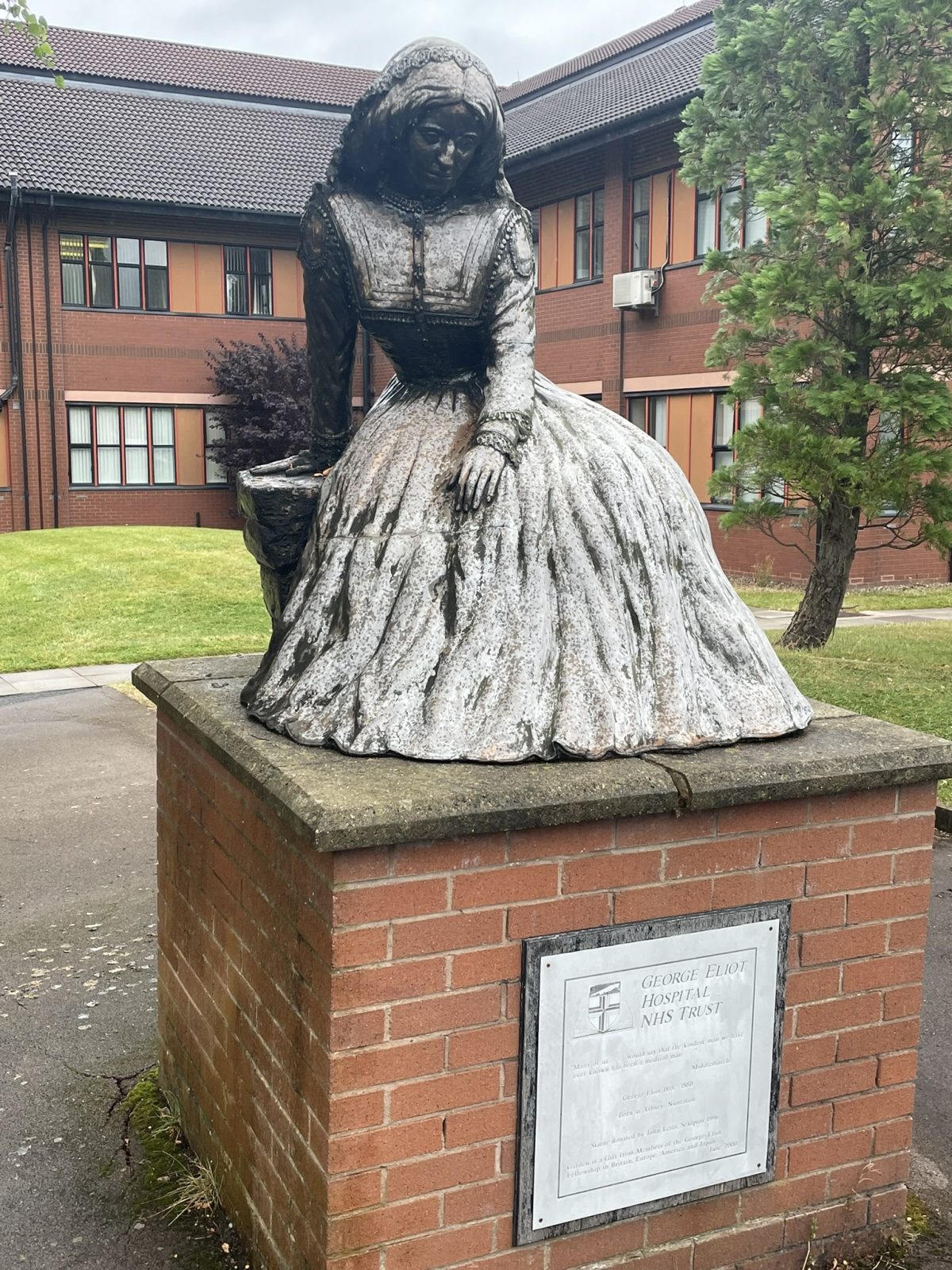
Photo: © Susan Docherty
Sculptor: John Letts (1930-2010)
Materials: Bronze
Unveiled: 29 August 1996.
George Eliot
George Eliot (1819-1880) was the pseudonym adopted by Mary Ann Evans in order for her writing to be taken seriously and published at a time when the idea of a female author would have met with disapproval. For more detail of her life see previous entry. This is a second bronze cast of the statue in Newdegate Square, Nuneaton, Warwickshire.
Location: George Eliot Hospital, Eliot Way, Nuneaton, Warwickshire.

Photo: Creative Commons, CC BY-SA 2.0
Sculptor: John Letts (1930-2010)
Materials: Statue: bronze; plinth: brick
Dimensions: Statue: h. 1.3m, w. 1.2m, d. 1.2m
Signed: Base of bronze: John Letts/1985
Unveiled: 22 March 1986 by Jonathan G. Ouvry, president of the George Eliot Fellowship, great-great grandson of G. H. Lewes.
George Eliot
George Eliot (1819-1880) was the pseudonym adopted by Mary Ann Evans in order for her writing to be taken seriously and published at a time when the idea of a female author would have met with disapproval. She is an internationally renowned novelist, whose works reflect provincial life in the Victorian era with perceptive characterisation and sharp psychological insight. She wrote several novels Middlemarch, Silas Marner and Mill on the Floss being perhaps among the best known. She was also an essayist, journalist and poet.
Eliot was born at Arbury which is near Nuneaton. From 1854 until 1878 she lived with the philosopher and critic, George Henry Lewes, a married man, who encouraged her writing. In 1880, she married John Walter Cross, but died in December of that year at 4, Cheyne Walk, Chelsea and is buried in Highgate Cemetery, London.
This statue was commissioned by the George Eliot Fellowship. There is a second later cast of 1996 outside the George Eliot Hospital, Nuneaton, Warwickshire.
For further information about this statue see G. T. Noszlopy, Public Sculpture of Warwickshire, Coventry & Solihull, LUP, 2003, p. 14.
Location: Newdegate Square, Nuneaton, Warwickshire.