

Photo: © Antony Dufort 2007
Sculptor: Antony Dufort FRSS SPS (b.1948)
Founder: Bronze Age Foundry
Materials: Bronze
Unveiled: 24 February 2007 by Margaret Thatcher
Margaret Thatcher
Margaret Hilda Thatcher, Baroness Thatcher of Kesteven (1925-2013) was a Conservative politician, who entered the House of Commons in 1959 as MP for Finchley in North London. She was Secretary of State for Education and Science (1970-74) and became leader of the Conservative Party in 1975. The following year she gave a speech vehemently criticizing communism, which resulted in her nickname ‘The Iron Lady’. Thatcher became the first female prime minister in Europe when she took office in 1979 and went on to win three consecutive terms, she was the only British prime minister to do so in the 20th century. Following her resignation as prime minister in 1990 she remained an MP until 1992, when she was made a life peer and entered the House of Lords. She became a member of the Order of the Garter in 1995.
The sculpture is located in the Members’ Lobby of the House of Commons on one of four plinths, together with Attlee, Lloyd George and Churchill. It was commissioned by the Speaker’s Advisory Committee on Works of Art whose Chairman at the time was Tony Banks (later Baron Stratford). The purpose of the sculpture was to celebrate her election as the first female British Prime Minister. It was unveiled by Thatcher herself, who commented after the ceremony ‘I might have preferred iron but bronze will do, and it won’t rust…’.
Location: Members' Lobby, Palace of Westminster, London.

Photo: John Owen Smith geograph.org.uk
Sculptor: Philip Jackson (b.1944)
Materials: Bronze
Flora Thompson
Flora Thompson (1846-1947), postal worker, novelist and poet, best known for her trilogy, Lark Rise to Candleford, much of her writing is autobiographical. She moved to Liphook in 1916 and lived there until 1928. Her portrait bust in bronze was unveiled in 1981 outside the Sorting Office, then after being vandalised, it was recast and re-sited inside Liphook Library in 1995.
Location: Liphook Library, Hampshire.

Photo: © Christine Charlesworth
Sculptor: Christine Charlesworth
Founder: Milwyn Casting, Molesey, Surrey
Materials: Statue in bronze; base in Purbeck stone
Unveiled: 31 March 2021
Greta Thunberg
Greta Thunberg (b. 2003), Swedish environmental activist, who campaigns about climate change and holds world leaders to account. She instigated School Strikes for Climate, spoke both at the 2018 UN Climate Change Conference and the 2019 UN Climate Action Summit. In 2019 she was the youngest ever Time Person of the Year. She has been nominated for the Nobel Peace Prize three times.Thunberg is depicted standing on a block of Purbeck stone, one hand clenched, her right arm stretched in front as if persuading people, her face looks as though she will speak with confidence. Charlesworth wanted to show that someone who had problems in life and who found mixing with people difficult, could still talk in public. The statue is designed to inspire other students, who may have their own problems, to take courage. Winchester University is one of the greenest in the country and this statue, called Make a Difference was funded through a percentage for art scheme from the costs of the new building. It is believed to be the first full-size statue of Thunberg.
Location: Outside the main entrance to the new building, West Downs Centre, Winchester University, Hants.

Photo: Richard Degg
Sculptor: Denise Dutton (b. 1953)
Founder: Castle Fine Arts
Materials: Bronze
Dimensions: h. 128.3 cm., w.93.7cm., d. 101.8cm.
Signed: on the flat of her right shoe, her foot lying on its side.
Unveiled: 14 December 2025 by the author, Tracy Chevalier.
Sylvia Townsend Warner
Sylvia Townsend Warner (1893–1978) was both an author and poet, and a musicologist and composer. Her first novel, Lolly Willowes (1926) established her literary talent. She was a prolific writer of short stories and contributed more than 150 to The New Yorker over 40 years. Warner was a political activist and a communist, who volunteered for the Red Cross during the Spanish civil war. A feminist pioneeer, she lived in rural Dorset with her partner, the poet Valentine Ackland. Their long-term relationship and public openness at a time when this was not generally acceptable established her as a trailblazer for lesbian visibility. Warner is now regarded as under-appreciated, although her reputation revived somewhat in the 1970s as a writer of sapphic literature when her work was published by Virago Modern Classics and there has been rather more interest in her work in recent years
This statue was commissioned by the charity Visible Women UK, which campaigns for greater representation of women in public art. The choice of Warner as the subject was decided by public vote. A cat lover, Warner is depicted with one of her feline companions at her feet. This is the first public statue of a non-royal woman in Dorchester.
Location: Outside Gould's department store, South Street, Dorchester, Dorset.

Photo: © Melanie Wilks
Sculptor: Melanie Wilks
Materials: Maltese limestone
Unveiled: 1 October 2013
Harriet Tubman
Harriet Tubman, born Araminta Ross, (c.1820 -1913) an abolitionist and political activist was known as the ‘Moses of her people’. An escaped slave from the South, she was a leading figure as a ‘conductor’ on the Underground Railroad, which helped hundreds of slaves to escape to freedom. During the American Civil War she worked as a nurse and cook, then as an armed scout and spy. She was active in the women’s suffrage movement. The Harriet Tubman Memorial was commissioned by Kirklees Council as part of Black history month to mark the hundredth anniversary of the her death. Wilks created the concept for the sculpture working with students from the Netherhall Learning Campus, Huddersfield. The plinth on which the portrait bust sits is carved with reliefs inspired by African art and culture. The work in Maltese limestone is signed and dated. It was unveiled on 1 October 2013.
Location: Huddersfield Library and Art Gallery, Princess Alexandra Walk, Huddersfield, West Yorkshire.

Photo: Wikimedia Commons CC BY-SA 4.0
Sculptor: Neal French
Materials: Bronze
Unveiled: 2012 by Twiggy
Twiggy
Twiggy (b.1949) This public sculpture, titled Grosvenor Group, is a realistic scene in which a passing shopper comes across Terence Donovan photographing the model Twiggy near to his Mayfair studio. Twiggy is depicted as she posed in a famous shot taken by Donovan in the swinging 60s wearing a moiré taffeta waistcoat and skirt designed by Mary Quant’s Ginger Group. In fact though Donovan did not move into his Bourdon Street studio until the late 1970s, at the time this shot was actually taken in the 1960s Donovan was still at his Yeoman’s Row studio in Knightsbridge. The bronze sculpture was unveiled in 2012. It was commissioned by Grosvenor Estates to mark the opening of their new building on Grosvenor Hill.
Location: Outside Bourdon House, Mayfair, London SW1.
Virginia Wade
Virginia Wade OBE (b.1945) tennis player, who is the only British woman to have won all four major tournaments. In 1977 she won the Wimbledon ladies singles title. Her portrait bust was commissioned to be displayed at Wimbledon.
Location: All England Lawn Tennis Club, Wimbledon
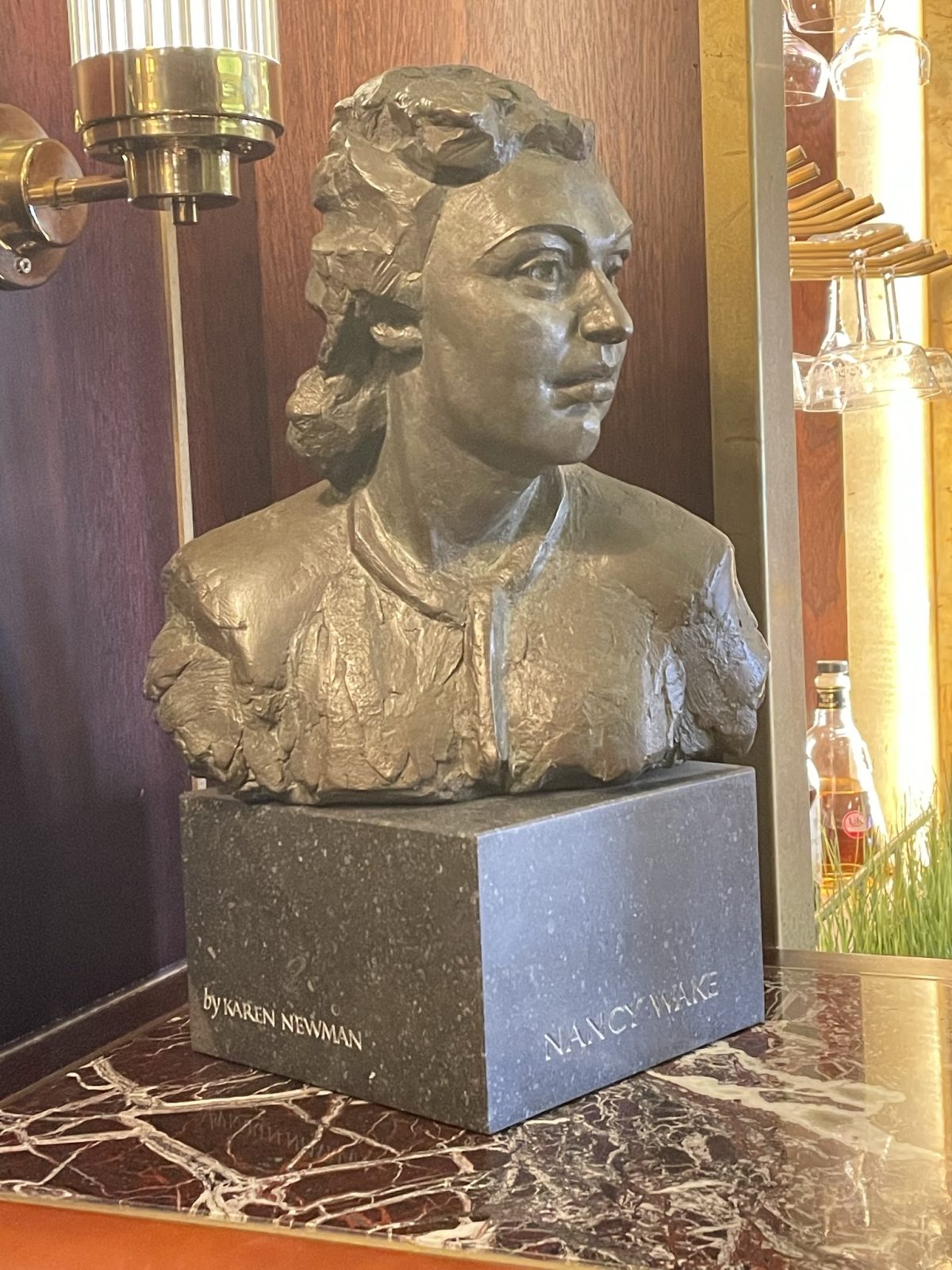
Photo: © Susan Docherty
Sculptor: Karen Newman (b.1951)
Unveiled: 2008
Nancy Wake
Nancy Wake, AC, GM (1912–2011), resistance fighter and secret agent. Wake was born in Wellington, New Zealand and was part Maori. She was brought up in in Sydney, Australia, but ran away at the age of 16 and became a nurse. After receiving a small inheritance, she travelled to New York and then to London, where she trained as a journalist. In 1939 she married Henri Fiocca, a wealthy French industrialist. When war broke out she was living in Marseilles and became an ambulance driver, but after the Franco-German armistice she helped refugees and military allies return to England via a network known as the Pat O’Leary line. The Nazis called her the’White Mouse’ because she skilfully evaded capture and this was the title of her autobiography (1985).She then went to England via Spain, where she joined the French section of the Special Operations Executive. She was awarded the George medal after the war, and returned to Australia, but some years after the death of her second husband, she emigrated to England and lived at the Stafford Hotel, London, which is where this bust is located. It had been an American and British forces club during the war.
Location: Bar of Stafford Hotel, St James Place, London SW1.

Photo: Public domain.
Sculptor: Emma Stothard (b. 1971)
Erected: 26 March 2021
Dora Walker
Dora Muriel Walker (1890-1980) was the first female skipper of a fishing boat in the North East and played a leading role in Whitby’s fishing heritage. Born in West Yorkshire, she was educated at Roedean and nursed at a Belgian hospital and then in Calais during WWI. Suffering from bronchial problems, she moved to Whitby on medical advice during WWII. She bought a fishing boat, the Good Faith, piloted boats through the minefields and was the only woman skipper who held a licence in the North Sea throughout the War. She was Honorary Keeper of the Whitby Museum and President of the Whitby Women’s Lifeboat Guild. She wrote several books, which include her memoirs and tales of fishing. The statue, consisting of a steel armature wrapped in hot-dipped galvanised steel wire, is part of a series of works completed by the sculptor on 26 March 2021 for Whitby’s Walking Heritage Trail.
Location: West Cliff, Whitby, North Yorkshire.

Creative Commons CC BY-SA4.0
Sculptor: Jemma Pearson
Founder: Castle Fine Arts Foundry in Llanrhaeadr
Materials: Bronze bust on plinth of Grinshill stone.
Unveiled: 2016
Mary Webb
Mary Webb (1881-1927), author, best known for her novel Precious Bane. Webb was born in Leighton a small village south of Shrewsbury. The bust was commissioned by the Mary Webb Society following a generous legacy from Muriel Furbank, a former member.
Location: Outside Shrewsbury Library, Shropshire.