
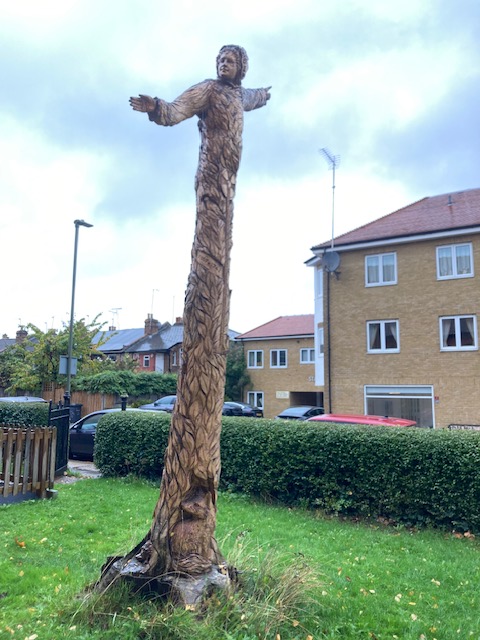
Photo: PSSA
Sculptor: Simon O'Rourke (b.1978)
Materials: Cypress wood
Dimensions: Approx. h. 6m.
Signed: Metal plaquette attached to the trunk: sculptor's logo/SIMON/O'ROURKE/ treecarving.co.uk/07886881815
Inscription: carved into tree trunk: 1669.1742 Susanna Wesley; carved into base next to hedgehog: Jane Ray
Susanna Wesley
Susanna Wesley (1669–1742) was a writer, theologian and teacher, who had 19 children, nine of whom did not survive. She was the mother of John and Charles Wesley, who founded the Methodist movement. For this reason and because her influential teaching inspired them, Susanna Wesley became known as ‘The Mother of Methodism’. She was active in the movement writing letters, a spiritual diary and scriptural commentaries for her own use. At a time when girls usually were not educated, she taught her daughters to read and they learned Latin and Greek, because she believed firmly in women’s education. One of her daughters Mehetabel Wesley Wright, known as Hetty, became a respected female poet.
This statue was carved in 2022 from a bare 20′ red cedar tree in the grounds of East Finchley Methodist Church. The church commissioned the sculpture to commemorate its bicentenary in 2019. It is the only known public sculpture of Susanna Wesley, she is depicted at the top with welcoming outstretched arms. The trunk of the tree is carved with leaves, animals including a fox, squirrel and rabbit, and birds such as an owl. Next to the hedgehog at the base of the trunk, the name ‘Jane Ray’ is carved, the senior church steward, who organised the project. Amongst the organic shapes, a beetle is hidden in the bark, which may explain why the statue is sometimes called ‘bug woman’.
Location: Methodist Church , East Finchley, London, N2.

Photo: © Juliet Rix
Sculptor: Gillian Brett
Materials: Bronze
Unveiled: 3 July 2025
Fanny Wilkinson
Fanny Wilkinson (1855–1951), Britain’s first professional female landscape gardener, developed a passion for gardening as a child, possibly inspired by the grounds of her family home, Middlethorpe Hall, Yorkshire. Having completed an 18-month course at the Crystal Palace School of Landscape Gardening and Practical Horticulture in London, which was intended for men, in 1884, she was elected as honorary gardener to the Metropolitan Public Gardens Association. In 1886, this became a paid position. In 1899, she co-founded the Women’s Agricultural and Horticultural International Union and in 1902 became the first female Principal of Swanley Horticultural College, Kent.
Wilkinson designed and laid out more than 75 public gardens and open spaces across London, including Goldsmith’s Square, Hackney; Paddington Street Gardens, Marylebone; and Vauxhall Park. In later life, she retired to Suffolk and bred prize-winning goats.
A suffragist and friend of Millicent Fawcett, Wilkinson championed women’s rights and equal pay. In her only known interview, published in the Women’s Penny Paper, 8 November 1890, she declared ‘I certainly do not let myself be underpaid as many women do. There are people who… think because I am a woman I will ask less than a man… I know my profession and charge accordingly, as all women should do.’
This portrait sculpture of Wilkinson stands in the Coronation Gardens, Wandsworth which she designed. Installed above the drinking bowl on a granite water fountain of 1904, it replaces a statuette which had disappeared. She holds a small plant, which the sculptor explains commemorates ‘her devotion to planning gardens’ and symbolises ‘the growing shoots of creativity’. The repeat motif of olive branches on the hem of her skirt references the Friends of Coronation Gardens’ logo. Putney School of Art and Design, Heritage of London Trust (HOLT), Friends of Coronation Gardens, Enable and Wandsworth Council were involved in the project.
Location: Coronation Gardens, Southfields, Wandsworth, London, SW18.

Photo: Simon Smith
Sculptor: Simon Smith
Materials: Marble
Unveiled: 20 September 2012 by Wilkinson's great, great, great niece, Rev Elizabeth Storey.
Kitty Wilkinson
Kitty (Catherine) Wilkinson (1786–1860) was an Irish migrant, known as the ‘The Saint of the Slums’, because she helped save the lives of many during the cholera epidemic of 1832 by inviting them to wash infected clothing and bedding in her domestic boiler. Ten years later with public funds raised through her efforts, a combined washhouse and public baths was opened in Frederick Street, Liverpool. This was the first public washhouse in the United Kingdom and she was appointed the first warden. Her statue was unveiled 2012 in St George’s Hall, Liverpool. It was the first sculpture of a woman to be installed there.
Location: St George's Hall, Liverpool.

Photo: Neil Crump, Wikimedia Commons
Sculptor: Scott Eaton (b.1973)
Materials: Bronze
Unveiled: 14 September 2014
Amy Winehouse
Amy Winehouse (1983-2011), singer and songwriter, who won the award for best British Female Solo Artist at the BRIT Awards 2007 and two Ivor Novello Awards. She was the first British woman to win five Grammys. Her statue in bronze features her characteristic beehive hairdo.
Location: Stables Market, Camden Town, London NW1.

Photo: Grim23 Wikimedia Commons
Sculptor: Maggi Hambling (b.1945)
Materials: Silvered bronze
Unveiled: 10 November 2020
Mary Wollstonecraft
Mary Wollstonecraft (1759-1797), writer, founding feminine philosopher, advocate of women’s rights, education and social equality, wrote A Vindication of the Rights of Woman (1792). Mary Shelley, author of Frankenstein, was her daughter. The memorial, entitled A Sculpture for Mary Wollstonecraft, is the result of a 10 year project by the Mary on the Green Campaign. The statue is on a plinth bearing Wollstonecraft’s words ‘I do not want women to have power over men, but over themselves’. It was erected at Newington Green, where she lived, worked and opened a Girls’ Boarding School.
Location: On roundabout, Newington Green, London N16.

Photo: Wildasyoulike, CC BY-SA 4.0, via Wikimedia Commons
Sculptor: Hazel Reeves
Founder: Bronze Age Sculpture Casting Foundry
Materials: Silicon bronze
Dimensions: h. 1.5m.
Unveiled: on International Women's Day, 8 March 2022 by Baroness Hale of Richmond
Elizabeth Wolstenholme Elmy
Elizabeth Wolstenholme Elmy (1839-1918) a campaigner for social, political and legal equality, she championed women’s, children’s and human rights, and was an influential figure in the women’s suffrage movement. Her name and image represent one of 58 sufffragists on the plinth of Gillian Wearing’s statue of Millicent Fawcett in Parliament Square, London. A passionate lobbyist she gave speeches, took part in marches and created 1600 petitions. Suffragette leader, Emmeline Pankhurst called her ‘the brains of the suffrage movement’, while reflecting Wolstenholme Elmy’s knowledge of the law, Lord Selbourne, the Lord Chancellor patronisingly dubbed her ‘Britain’s Little Lord Chancellor’. Apart from her important role in campaigning for women’s suffrage, particular areas where her work helped bring change were girls’ and women’s education and the part she played in the passing of the Married Women’s Property Act (1870),the Repeal of the Contagious Diseases Act (1886) and the Guardianship of Infants Act (1886). She wrote poetry, contributed articles to newspapers under the pseudonym Ignota and held progressive views on free love, atheism and republicanism.
Her statue, Our Elizabeth, by Hazel Reeves stands in the town centre of Congleton where Wolstenholme Elmy lived for many years. The statue was commissioned by Elizabeth’s Group, a local charity set up to to raise awareness of her national contribution to women’s rights.
Location: Centre of Bridge Street, Congleton, Cheshire

Photo: Noshplar Wikimedia Commons
Sculptor: Graham Ibbeson (b.1951)
Materials: Bronze
Unveiled: 17 May 2019 by Wood's close friend, the comic actor, Ted Robbins.
Victoria Wood CBE
Victoria Wood (1953-2016), BAFTA award winning comedian, actress, singer, pianist, writer, composer, producer and director. Wood was brought up in Bury, her statue has been erected opposite her local library. The statue was a joint project between Bury Council and Victoria Wood’s Estate.
Location: Library Gardens off Silver Street, Bury, Greater Manchester

Photo: Juliet Rix
Sculptor: Marcia Bennett-Male
Materials: St Bees sandstone
Dimensions: h.1. 6m.
Unveiled: 28 June 2025
Mary Woolaston
Mary Woolaston , a black woman, who in the late 17th century is believed to have been the keeper of a healing well, renowned for its chalybeate waters, these are natural spring waters that contain a high concentration of iron salts, which gives them a distinctive taste. Woolaston lived in a rough, circular stone hut near the well. The spot which became known as ‘Black Mary’s hole’ is in the Calthorpe Community Gardens, where this statue entitled Black Mary now stands. Black Mary was made by Marcia Bennett-Male, who is the only classically trained black woman stone carver in the UK. The statue was commissioned in 2020 and joins the meagre, but slowly growing number of statues of black women in the UK. It formed part of the The Black Mary Project financed by the Mayor of London’s Untold Story fund as part of his Diversity in the Public Realm programme, and also by Arts Council England, Camden Council, and the Paul Hamlyn Foundation.
Location: Calthorpe Community Gardens, Gray's Inn Road, London, WC1

AndyScott, CC BY-SA 4.0, via Wikimedia Commons

Sculptor: Laury Dizengremel
Materials: Bronze
Unveiled: 16 November 2022 by Emma Woolf, her son Ludo and Sophie Partridge, descendants of Virginia Woolf.
Virginia Woolf
Virginia Woolf (1882-1941) was an innovative and influential modern novelist, who favoured the ‘stream of consciousness’ genre. Mrs Dalloway (1925), To The Lighthouse (1927) and Orlando (1928) are among her best known works. She was also a literary critic, essayist, biographer and conservationist. She suffered mental health problems, which led to her committing suicide.
This statue is sited at Richmond where Virginia Woolf lived with her husband, Leonard, from 1913-1924. It was here in the interwar years that they purchased a small hand-printing press and established The Hogarth Press, named after their home Hogarth House in Paradise Road, Richmond. At first they printed their own works, but gradually expanded this to include those of their friends and acquaintances; eventually the hand-press could not cope with demand and their printing became a commercial concern.
Location: Upper terraces, Richmond Riverside, Richmond-upon-Thames

Photo: Stu’s Images Wikimedia Commons
Sculptor: Stephen Tomlin (1901-1937)
Materials: Bust in bronze, plinth in Portland stone
Erected: 26 June 2004 by the Virginia Woolf Society of Great Britain
Virginia Woolf
Virginia Woolf (1882-1941) was an innovative and influential modern novelist, who favoured the ‘stream of consciousness’ genre. Mrs Dalloway (1925), To The Lighthouse (1927) and Orlando (1928) are among her best known works. She was also a literary critic, essayist, biographer and conservationist. She suffered mental health problems, which led to her committing suicide.
She lived on the south side of Tavistock Square (1924-39). The sculptor, Stephen Tomlin, who was part of the Bloomsbury set, first suggested sculpting her in 1924, finally she gave him six sittings in 1931. His is the only sculptural representation of her from life. This bronze portrait bust on a Portland stone plinth was erected in 2004. There are replicas of the bust at Monk’s House (NT) Rodmell, Lewes; in lead (1931) at the National Portrait Gallery, London and a third later cast at the British Library (1990).
Location: Tavistock Square, London WC1