

Photo: Peter Holmes / Ann Glanville, Fore Street / CC BY-SA 2.0
Materials: Fibreglass
Unveiled: 5 September 2013
Ann Glanville
Ann Glanville (1796-1880) a champion rower, who raced Cornish pilot gigs (six-oared wooden rowing boats). Her statue was originally sited in Fore Street, Saltash, but in 2018 was relocated to Saltash waterside.
Location: Saltash waterside, Cornwall

Photo: By Cmglee – Own work, CC BY-SA 3.0. Public Domain, Commons Wikimedia.
Sculptor: Sir William Reid-Dick K.C.V.O RA (1878-1961)
Founder: Morris Singer
Materials: Sculpture in bronze; pedestal in Portand stone
Signed: Yes
Unveiled: 22 October 1949
Listed: Grade II* (1031589 ) 15.04.1998
Lady Godiva
Lady Godiva ( -1067) was a religious woman renowned for her generous gifts to churches and abbeys. Her birth date is unknown, but her marriage to Leofric, Earl of Mercia in c.1035 is chronicled. She was a wealthy landowner in her own right. Godiva pleaded with her husband to reduce the heavy taxes on the people of Coventry and he promised to do so if she would ride naked through the city. She ordered the people of Coventry to stay indoors, cover their windows and close their doors and made a cloak of her hair to cover herself. The story of her ride was first told in the 12th century. This striking lifesize equestrian bronze statue, entitled Self-Sacrifice, representing Godiva on her ride, was sculpted by William Reid-Dick and was commissioned by W.H. Bassett-Green, a Coventry industrialist, who presented it to the city. The Historic England listing entry explains that this public sculpture ‘symbolised the regeneration of Coventry after its bombing and was donated to boost morale at a time when rebuilding work was delayed by shortages.’ In its original location facing the clock tower of Broadgate House (where it could be seen by ‘Peeping Tom) it created a focal point for Broadgate. In 1990 it was turned around and now faces the Upper Precinct. The design of the pedestal is similar to the work of Sir Edwin Lutyens (d.1944), who had been a friend of Reid-Dick. The pedestal is inscribed on two sides with lines from Lord Alfred Tennyson’s poem ‘Godiva’, the name of Bassett-Green, the donor, is on the third. For further details see George T. Noszlopy, Public Sculpture of Warwickshire, Coventry & Solihull, LUP, 2003, pp. 124-25.
Location: Entrance to Broadgate shopping centre, Coventry.
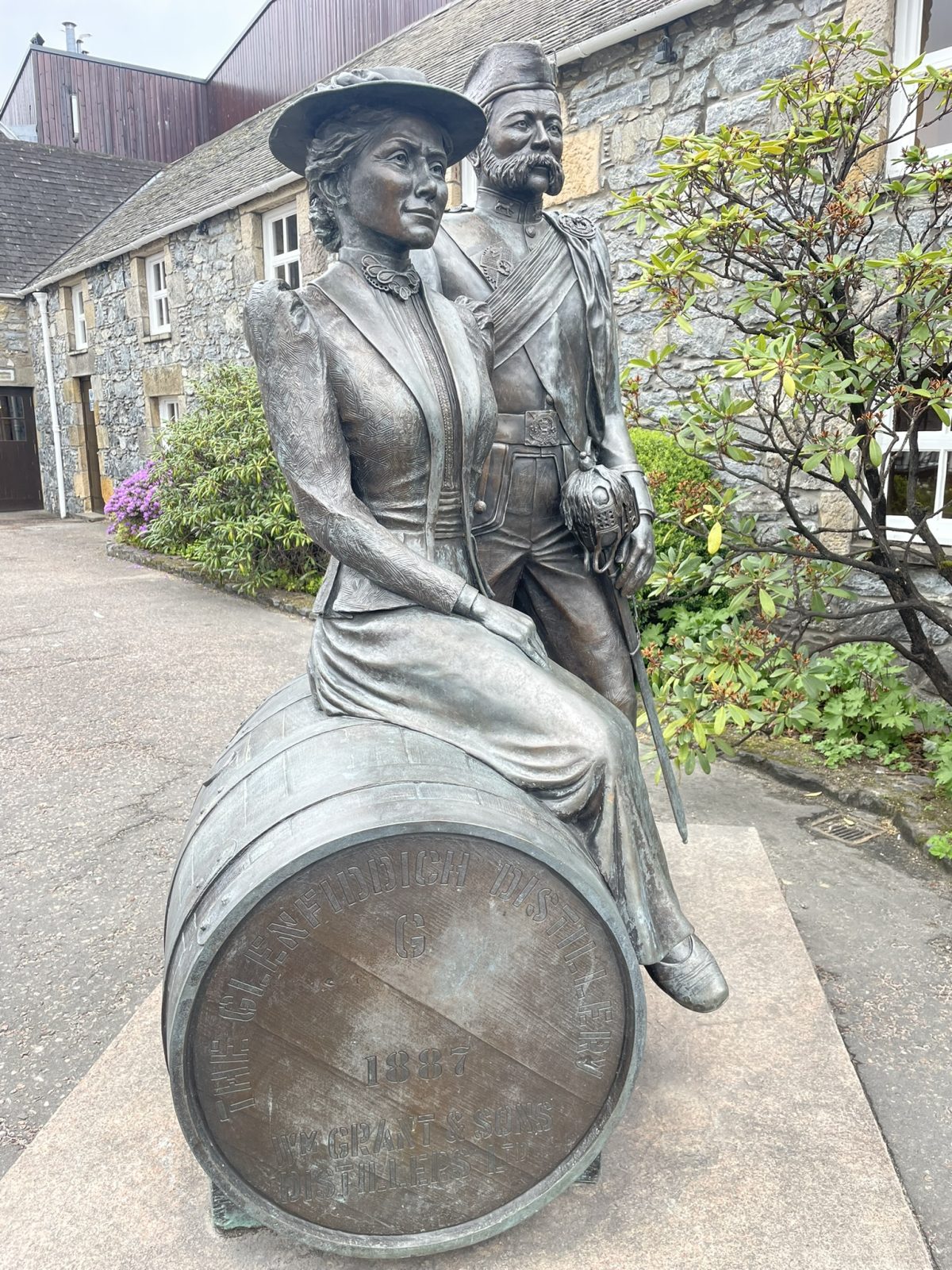
Photo: © Susan Docherty
Sculptor: Lois Carson (b.1961)
Founder: Black Isle Bronze Ltd
Materials: Bronze
Elizabeth Grant
Elizabeth Grant (1842-1925) is depicted with her husband William, dressed in his Gordon Highlanders’ uniform, in a bronze sculpture commissioned by Glenfiddich Distillery, which was unveiled in 2018. The couple married in 1860, founded the Distillery in 1886 and had two daughters and seven sons. Glenfiddich is one of the few single malt distilleries which is still entirely family owned.
Location: Glenfiddich Visitor Centre, Dufftown, Scotland.

Photo: Terry Cavanagh
Sculptor: Unknown
Architect: George Kay Green
Materials: Unknown
Dimensions: Statue h. (est.) 2.2m.
Nell Gwynn
Nell Gwynn (1650—1687), originally named Eleanor Gwynn, was a celebrated English actress and mistress of Charles II. Thought to have been of ‘low-birth’ she appears to have led a rags-to-riches life. First employed as an orange-girl in Drury Lane Theatre, she quickly became the mistress of its leading actor, Charles Hart, first appearing on the stage herself in late 1665. Spirited and good humoured, Nell was a popular figure. Described by Samuel Pepys as ‘pretty, witty Nell’, she is reputed to have been an excellent singer and dancer, but not suited to serious drama. By 1666 she had become a leading comedienne of the King’s Company with John Dryden writing many of her parts. In 1669 she became the mistress of Charles II, making her final stage appearance in Dryden’s Conquest of Granada by the Spaniards a year later. Thereafter, the King set her up in a fine house, where she entertained him and his friends. She never received a title herself, but secured them for her two sons by the King. Her younger son died in childhood; the elder Charles Beauclerk, was created Duke of St Albans. James II supported her after the death of Charles II, who on his deathbed had instructed his heir, ‘Let not poor Nellie starve.’
This twentieth century statue of Nell Gwynn occupies a niche above the main entrance of Nell Gwynn House, an apartment block in Chelsea. She is depicted wearing Restoration period dress with a Cavalier King Charles spaniel at her feet. Her association with this area of London, however, is uncertain and may be apocryphal.
For details of the further two sculptures on this facade, see Terry Cavanagh, Public Sculpture of Kensington and Chelsea with Westminster South-West, Watford, 2023, p.88.
Location: Sloane Avenue, London, SW3.

Photo: Kiran Parmar Wikimedia Commons
Sculptor: Sean Hedges-Quinn (b.1968)
Materials: Bronze
Unveiled: 4 February 2018
Alice Hawkins
Alice Hawkins (1863-1946), major figure in the Leicestershire Suffrage Society. This bronze statue was unveiled in 2018.
Location: Green Dragon Square, Leicester.

Photo: Ciaran Roarty Wikimedia Commons
Sculptor: Arthur Dooley (1929-1994)
Materials: Scrap iron and fibreglass
Erected: December 1979
Dolores Ibarruri
Dolores Ibarruri (1895-1989), activist, who fought for the Republican cause against Franco in the Spanish Civil War 1936-39. She was known as ‘La Pasionaria’, (the Passionflower). Commissioned by the International Brigade Association of Scotland as a memorial to the 2,100 British volunteers who fought for the Republican cause in the Spanish Civil War. The memorial has an inscription dedicated to the 534 volunteers who died, 65 of whom were from Glasgow. The plinth bears Ibarruri’s slogan ‘better to die on your feet than live forever on your knees.’ Erected in 1979, the statue was created from scrap iron and fibreglass and fell into disrepair, it was restored in 2010.
Location: On the banks of the Clyde between Jamaica Street and Howard Street, Glasgow, Scotland.

Photo: Nilfanion Wikimedia Commons
Sculptor: O. P. Pennacchini
Designer: Sir Hubert Jerningham (Lady Jerningham's husband) and Walter Ingram
Materials: Statue white marble, base grey granite.
Signed and dated: O. P. Penachini
1906
Erected: 1908
Listed: Grade II (1041699) 20.05.1971
Lady Annie Jerningham
Annie, Lady Jerningham (1850-1902), philanthropist. She was first married to Charles Mather of Longridge Towers, Berwick. Hubert Jerningham, a British diplomat and Member of Parliament for Berwick (1881-1885) was her second husband and the designer of this memorial. She is depicted sitting with her two dogs, the larger looks up at her with its paw resting on her lap, and she rests her hand on the smaller which is at her side. The Historic England listing comments that this is ‘a life-size monument of high aesthetic quality in scale and detailing and which displays considerable sculptural merit; it occupies its original location, visible from the subject’s home,’ at Longridge Towers.
Sources: Historic England and Paul Usherwood et al., Public Sculpture of North-East England, Liverpool, 2000, pp. 14-15.
Location: Bankhill, Marygate, Berwick-upon-Tweed, Northumberland.

Sculptor: Neil Simmons (b. 1952)
Designer: Tim Crawley, Rattee & Kett, Cambridge
Materials: Richemont Limestone
Unveiled: 1998 by the Archbishop of Canterbury, Dr George Carey
Erected: 9 July 1998
Esther John, born Quamar Zia
Esther John, born Quamar Zia ( 1929—1960) is one of ten modern martyrs, whose statues were installed over the Great West Door of Westminster Abbey in 1998 Although born into an Islamic family, she attended a Christian school in India, where she was inspired to convert to Christianity by one of her teachers and by reading the Old Testament. On partition in 1947 her family moved from Madras to Pakistan, where she made contact with a missionary, Marian Laugesen, who gave her a copy of the New Testament and encouraged her study of Christianity. Seven years later she ran away from home because her parents expected her to marry a Muslim man. Working for an orphanage in Karachi, she was baptised and took the name of Esther John. In 1955 she moved to Sahiwal in the Punjab, where she worked in a hospital mission. Later in the following year she entered the United Bible Training Centre in Gujranwala. In Spring of 1959 having completed her training, she moved to Chichawatni where she evangelized in the villages, travelling around on a bicycle and teaching women to read. In February 1960, Esther John was found at her home having been brutally murdered.
Location: Niche over Great West Door, Westminster Abbey, London SW1.

Photo: © Copyright Jennifer Petrie from geograph.org.uk
Sculptor: Stephen Melton (b.1964)
Materials: Bronze
Unveiled: 30 September 2016 by Maureen Lipman, whose mother was born in the same road as Amy.
Amy Johnson CBE
Amy Johnson CBE (1903-1941), pioneering aviator, first woman to fly solo from England to Australia. The statue, a life-size bronze, was commissioned by the Amy Johnson Herne Bay Project, Amy Johnson Festival and Keepmoat to mark the 75th anniversary of her tragic death. It forms the focal point of Keepmoat’s housing development at Hawthorne Avenue, Hull. Amy Johnson was born in St George’s Road close by.
There is an identical cast at Herne Bay, Kent. This statue differs only in the quotations inscribed on it. One taken from her autobiography reads, ‘Had I been a man, I might have explored the Poles or climbed Mount Everest, but as it was, my spirit found outlet in the air.’
Location: Hawthorne Avenue, Hull, East Riding of Yorkshire.

Irid Escent, CC BY-SA 2.0, via Wikimedia Commons
Sculptor: Stephen Melton (b.1964)
Materials: Bronze
Unveiled: 17 September 2016 by HRH Prince Michael of Kent
Amy Johnson CBE
Amy Johnson CBE (1903-1941) was a pioneering aviator and first woman to fly solo from England to Australia. She died when her aircraft ditched in the Thames Estuary in 1941, her body and her plane were never recovered. This life-size bronze depicting her in her flying gear scanning the sky was commissioned by the Amy Johnson Herne Bay Project, Amy Johnson Festival and Keepmoat to mark the 75th anniversary of her tragic death close to Herne Bay. There is an identical cast at Hawthorne Avenue, Hull.
Location: The promenade, Herne Bay, Kent.